

S&P 500 -13.6% YTD after “Liberation Day”
The S&P 500’s 5% decline over the first quarter was compounded by a 7% decline in the first week of April, following the announcement by US President Trump last week of a “base” tariff rate of 10%, and an additional “ad valorem” duty for 60 countries with large trade deficits with the US. The stock market reaction was very negative. Since President Trump’s Inauguration, the S&P 500 is down a cumulative -16.4%, with only Richard Nixon (-7.2%) and George W Bush (-13.6%) having similar negative starts.
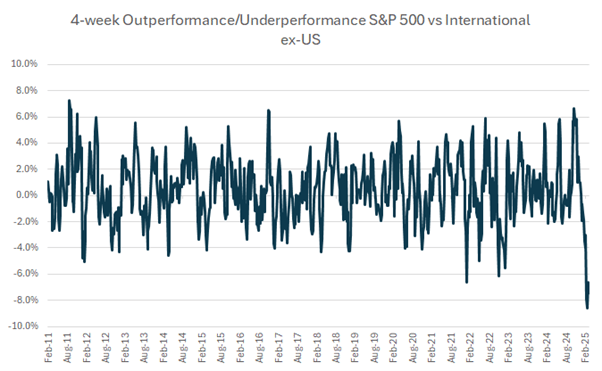
The first quarter of 2025 also saw the strongest 4-week outperformance of non-US stocks over US stocks (measured by VXUS vs VOO) since 2011 – see chart below.
Expectations are, despite the turmoil, that the long-term tariff rates end up closer to the 10% base rate : Firstly, some of the “ad valorem” duty rates are absurd – with countries such as Lesotho and Mauritius being subjected to the highest rates (40% and 30%). There are also signs that Trump wants a deal- Trump himself gave an interview on Air Force One after the announcement arguing that the “tariffs give us great power to negotiate”.
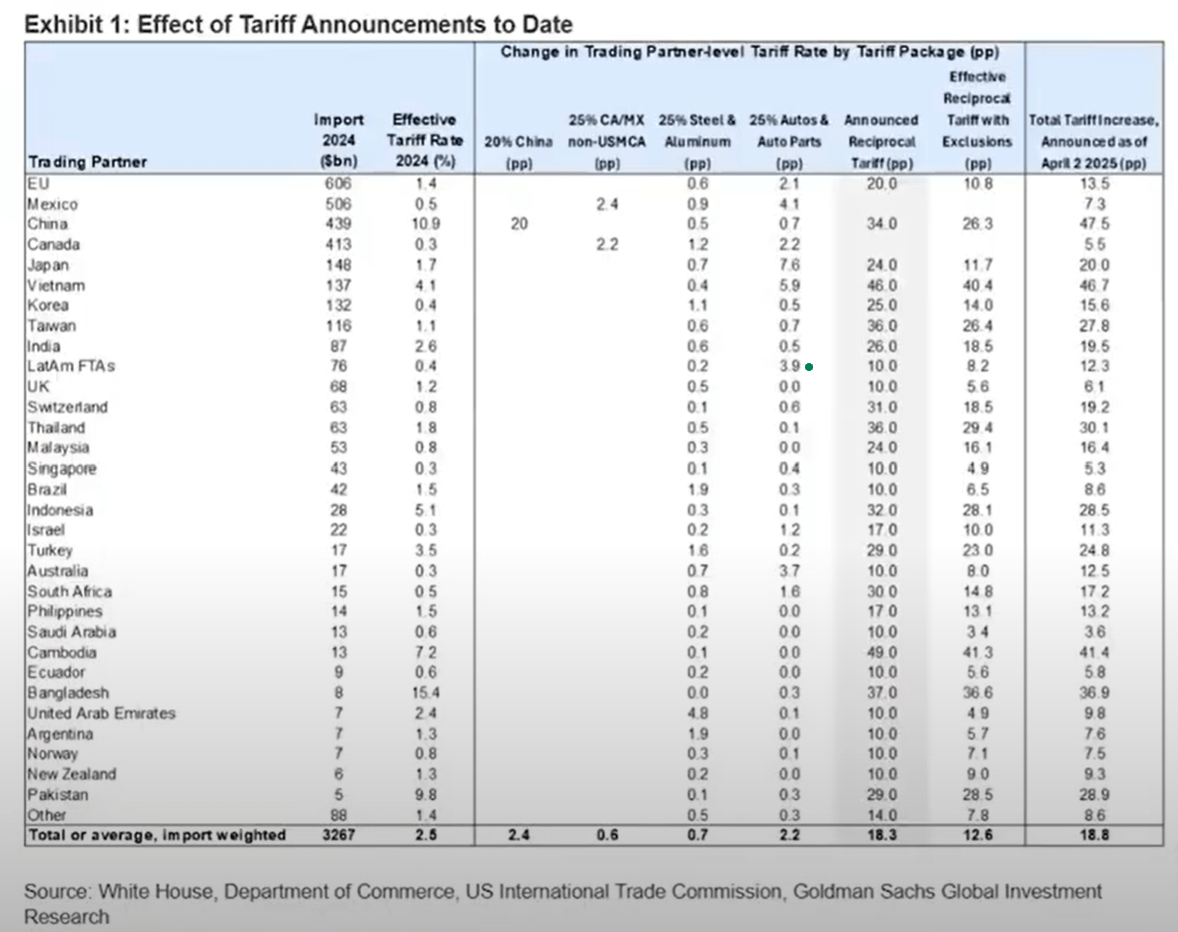
The total tariff increase, according to Goldman Sachs, is 18.8%. Canada, Mexico and others are negotiating separately, while some products, such as gold and oil, have exemptions.
The stock markets of the seven countries and regions with the biggest exports to the United States have outperformed the US since the 1st January, with particular outperformance last week for Mexico. This could be a positive sign.
The EU and five countries (China, Japan, South Korea, Canada and Mexico) together would represent 70% of imports. These largest trading partners have three options: retaliate, do nothing, or “make a deal”. Mexico and Canada are already negotiating with the United States, while it is also likely that Korea and Japan will make a deal. While experts are not sure with regards to Europe, China is likely to eventually negotiate despite an initial retaliatory salvo. Trump specifically used China as an example in his post-announcement interview, suggesting that lower tariffs could be offered in exchange for China approving the acquisition of TikTok’s US business by a US-aligned company.
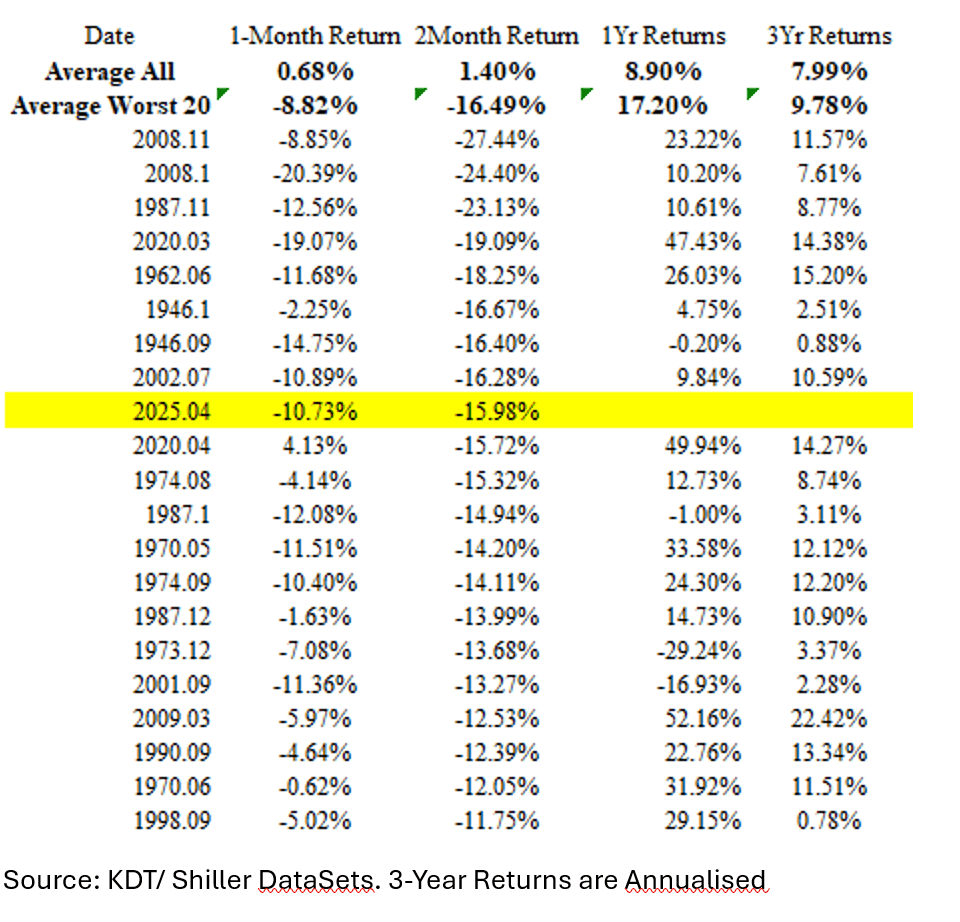
If Europe and China do not negotiate with the United States, there is a risk of recession. JPMorgan argues that there is a 60% chance of recession if the Tariffs are sustained. Despite this, we remain optimistic on the forward returns for the stock markets. The two-month decline in the S&P 500 of 15.98% is the 9th worst since 1945. On average, the 1-year forward return following the worst 20 two-month declines has been 17.2%, or double the 9% average annual return. The three-year forward average annual return has also been better than average for the worst two-month periods since 1945.
Some Thoughts on US Economic Policy
“Annual Income twenty pounds, annual expenditure nineteen and six, result happiness. Annual income twenty pounds, annual expenditure twenty pounds ought and six, result misery”.
-Wilkins Micawber, David Copperfield
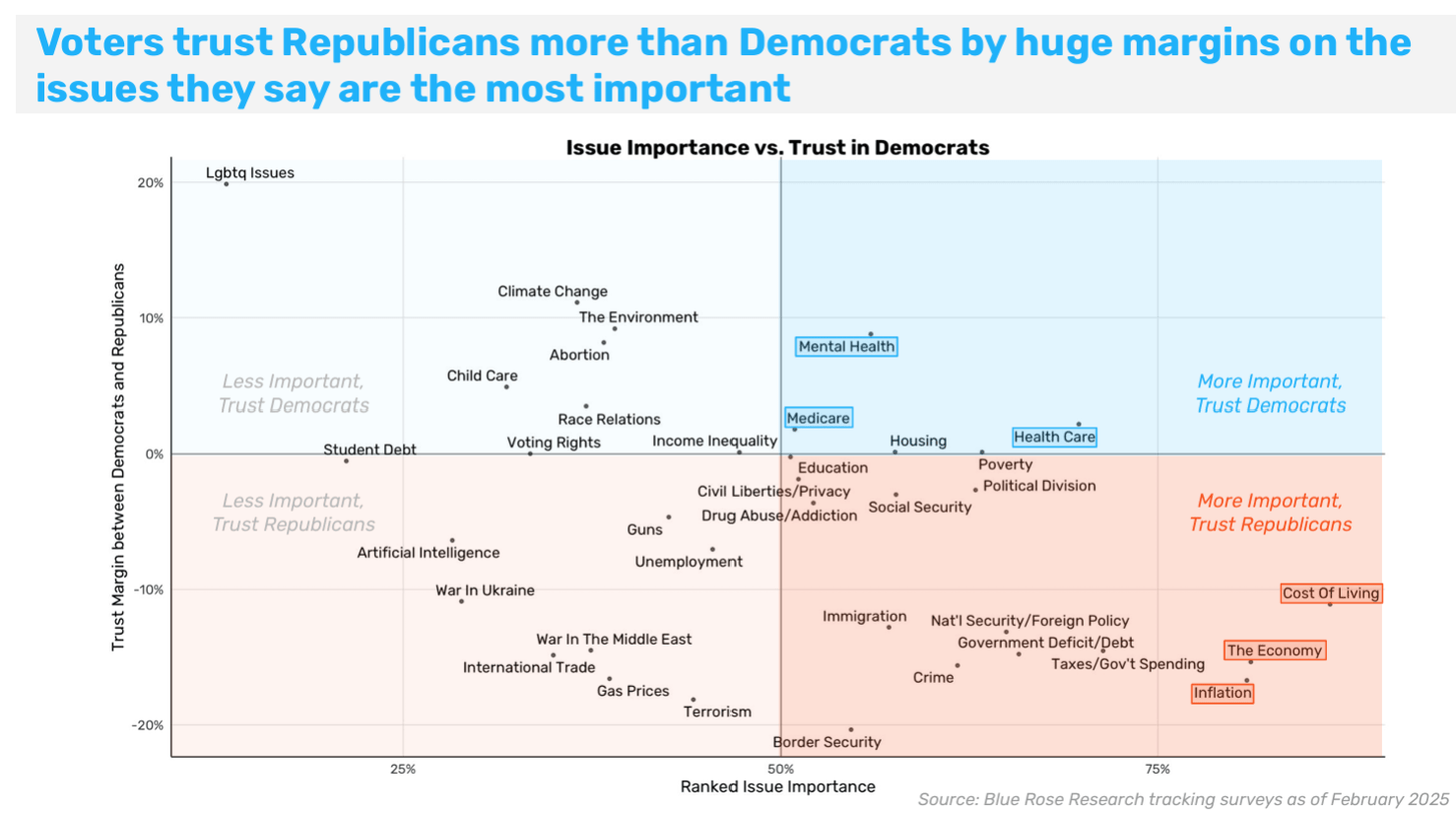
The Republican party gained control of the Senate, Congress and the Presidency with a mandate to improve the economy and reduce inflation. This can be seen in the below chart prepared by Blue Rose Research: Cost of Living, the Economy and Inflation were the most important issues for voters, and Republicans were seen as significantly more trusted to deal with these issues than Democrats.
In a recent interview, Treasury Secretary Scott Bessent identified the “common man index” as evidence of why so many voters were unhappy with the economy. Since 2021, the basket of goods that people “must buy regularly” has risen 20%, while wages have grown by 15%. Bessent’s three-pronged approach is as follows:
- Low and predictable taxes
- Slashed regulations
- Cheap energy
With regards to taxes, Bessent believes that the most important thing is to bring government spending under control. His view is that Federal “outlays”, at 23% of US GDP, are unacceptably high. Bessent rejects “Neo-Keynesian” thinking that governments must keep spending to “prop up” the economy, particularly when government does not reduce spending during times of economic growth. Bessent’s argument is that aggressive cost cutting strategies such as those employed by DOGE are essential because, “if you don’t act fast, vested interests will weigh you down”. One example Bessent gave was the consulting firm Booz Allen Hamilton, which gets 98% of its revenue from government consulting contracts. Bessent believes that there is broad public support for a cut in entitlement spending too (which includes programs such as Social Security, Medicare and Medicaid).
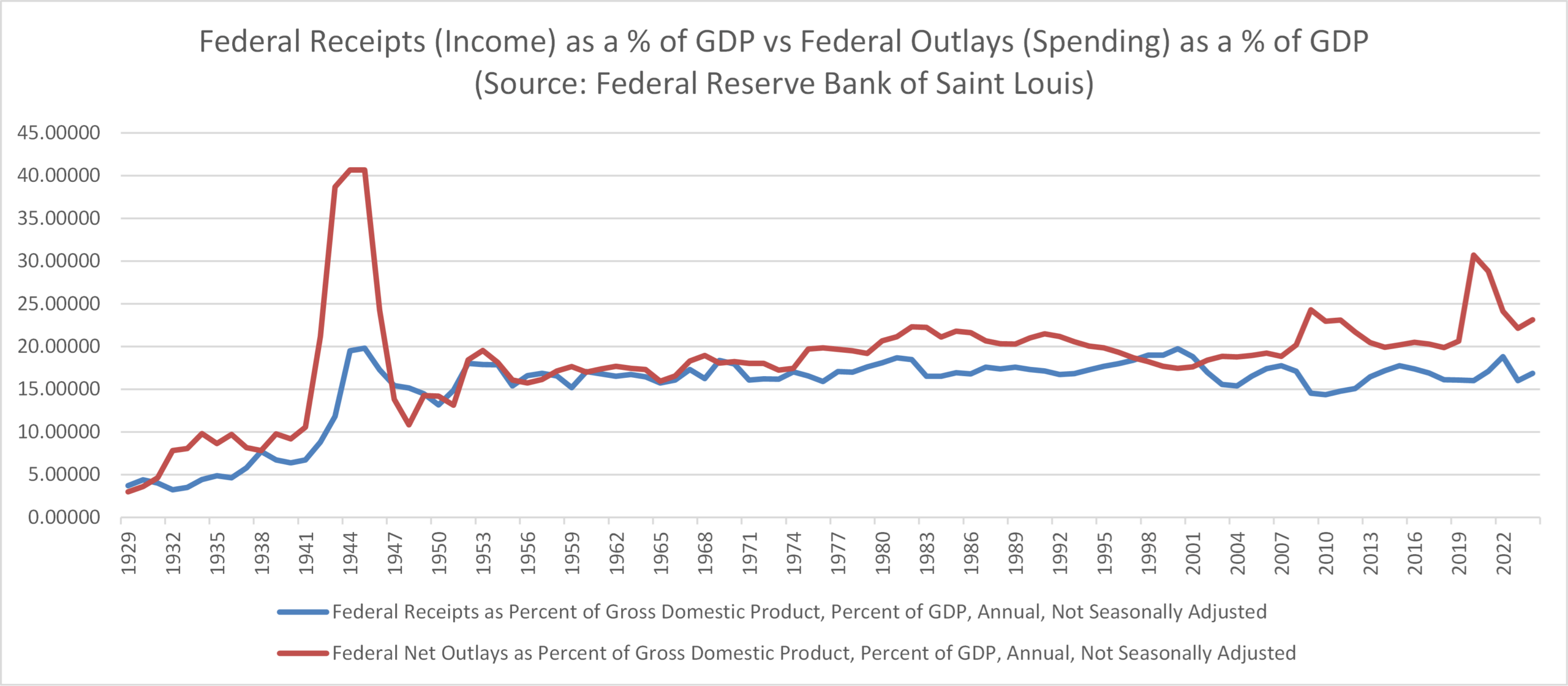
Tariffs are, to Bessent, a tool to be used when needed to “bring the other countries into line”. Ultimately, Bessent believes that tax cuts and deregulation will grow GDP. The regulator’s incentive is to “keep tightening the regulatory corset”. For Bessent, the Federal Reserve has been too harsh on small business banks, which are 70% of agricultural loans and 40% of small business loans. Bessent also takes issue with the high reserve requirement ratio imposed on banks in the name of financial “stability”. Banks are required to keep a percentage of bank deposits in US Treasuries with the Federal Reserve- and the Treasury Secretary would like to change this.
Bessent’s pro-growth policies also included speaking with admiration on Australian Superannuation Funds, which have “as much on their balance sheet as Social Security but with 7% of the population”. Following the example of North Dakota’s $11billion Sovereign Wealth Fund could help Americans get a “better return” than the 4-5% offered by United States Treasury bonds (Social Security invests solely in a form of US Treasury bonds). Biden’s Inflation Reduction Act, or IRA, has proven popular and Bessent looks set to broadly support it. If the United States is to compete on manufacturing, it will need to have a “zero incremental cost” of energy, which will require investment in both fossil fuels and renewable energy sources.
The interview suggests that Trump’s administration will be supportive of the financial sector, and renewable energy companies may still have a home in the administration. The Trump administration has started with much sound and fury- it is still possible that the markets could improve as other, more pro-growth policies, are unveiled by the administration.