

Fastest-ever recovery back to a closing high after a 15% correction
The S&P 500 had a steep correction in the early part of the quarter, as Trump’s “liberation day” announcement triggered the third bear market (or more than 20% decline) in the S&P 500 index since 2020. A subsequent reduction in trade tensions, or 90 day “pause”, helped US markets recover to new all-time highs. This marked the fastest ever recovery back to a closing high after a decline of at least 15%, according to Dow Jones Market Data. Investment banks such as UBS now believe that the US effective tariff rate will settle around 15% – well below the level envisaged by the 2 April “Liberation Day” announcement but nevertheless the highest US levels since the 1930s. The strong market recovery represents the view that the resilience of the US consumer and the adaptability of global supply chains should help cushion the blow.
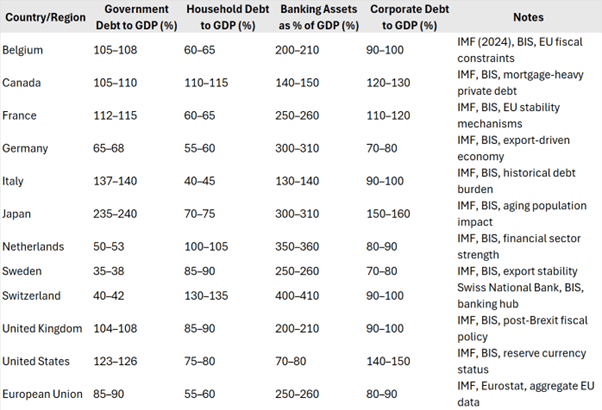
In addition, the US dollar index fell to a three-year low in late June amid uncertainty over the US tariff and economic outlook. There are many perceived reasons for US dollar weakness, particularly the level of the US deficit. At around 123%, the US debt to GDP ratio is lower than Japan (exceeding 249%) and Italy (134%). The US spends the highest share of revenues on interest of the countries surveyed by the International Monetary Fund, with a net cost of debt to general government revenues of 12.5% as of May 2025.
Although the news cycle is currently focused on government levels of debt, we would encourage investors to include private and company-level debt when assessing the “stability” of a country. This is particularly relevant when considering a country like Switzerland, which has a national debt to GDP of 40% (an admirable figure!) but at the same time bank assets at 397% of GDP – leaving the country potentially vulnerable in the event of a banking crisis. The table below shows debt across these different groups within a country in addition to debt to GDP. The table also can show the risks of just considering figures “in isolation” without thinking about context; for example, US Corporate Debt to GDP at 140% looks like a high figure, particularly when compared against other countries. It is worth noting, however, that the market capitalization of US companies as a percentage of US GDP is now around 200%, reflecting the fact many global businesses are headquartered in the US despite the majority of their sales not being there (for example, Apple’s non-North American sales account for approximately 60% of revenue).
Although short-term shifts in exchange rates can create fluctuations in portfolio values, we would encourage clients to be wary of “simple” explanations. In the long term, investments in a portfolio of companies should give clients exposure to the global economy, hopefully preserving and growing savings in the process whilst offsetting any short-term changes in currency values.
Comparing today’s top companies to the top companies in the mid-1990s
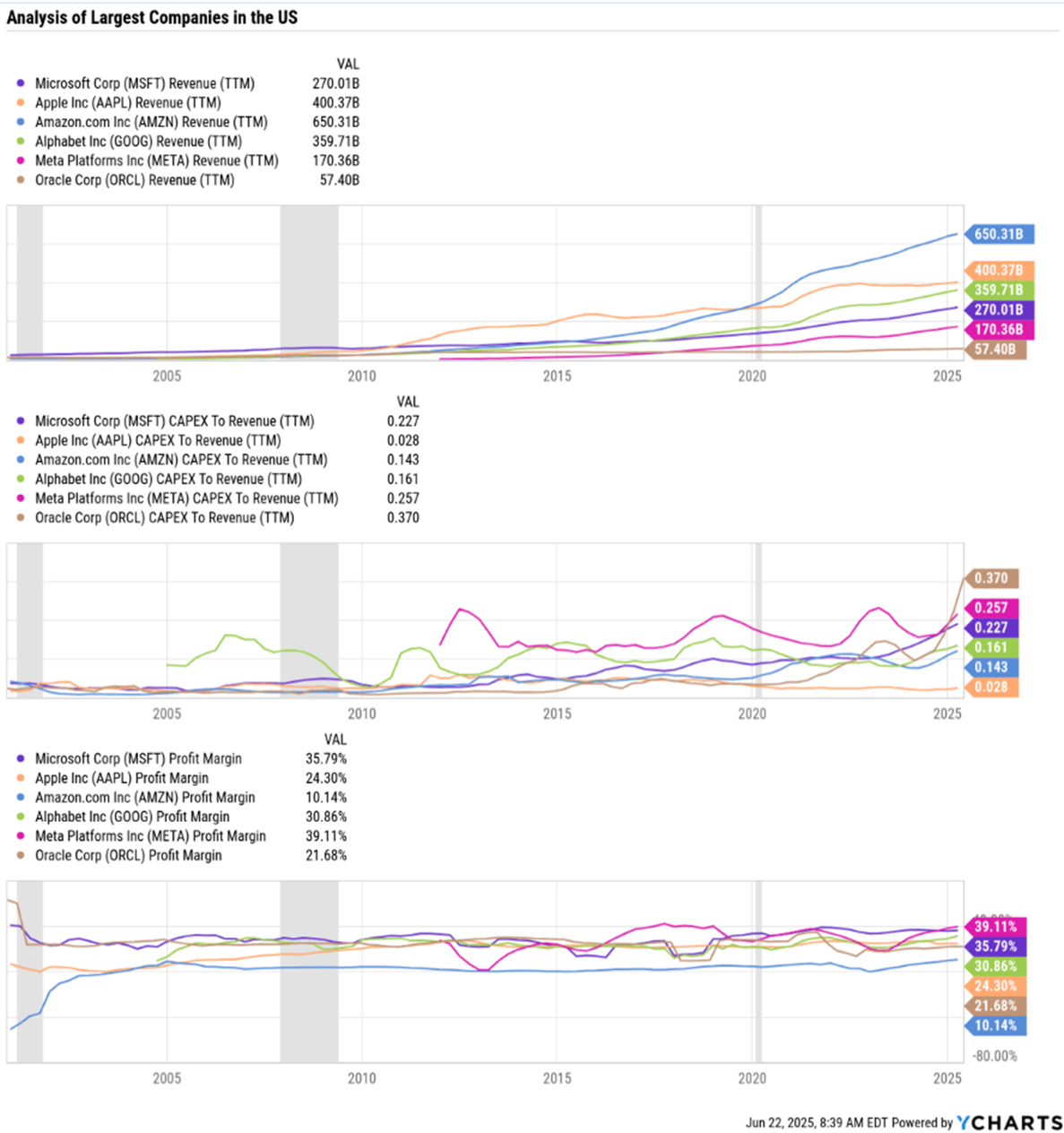
One of the things that stands out about the largest companies in the US today is that they are much more profitable than in previous years. To the end of March 2025, Meta reported a 39% net profit margin on $170bn of revenue, while Microsoft has a margin of 36% on $270bn of annual revenue. These high levels of profitability are particularly impressive when compared to some of the top performing shares in the 1990s. Even Intel’s profitability during the 1990s never exceeded 30%, while Cisco, a similarly fast-growing stock, had a net profit margin of 18% by 1997. Some of the largest companies in the mid-1990s, such as AT&T, Exxon and IBM, did not have a net profit margin above 10%. Given that today’s largest companies are much more profitable, it is perhaps justified that these companies should be more expensive.
Nevertheless, one thing to monitor is the heightened level of expense related to the boom in Artificial Intelligence spending. Amazon, Apple, Microsoft, Meta and Alphabet, plan to dramatically increase Capital Expenditure as a percentage of their sales. Microsoft, Oracle and Meta are spending more than 20% of their revenue on capital expenditure, while Amazon is spending over $90billion. The total annual amount, $400 to $500billion, is on a government-level scale. For example, the “Inflation Reduction Act” promised to spend between $40bn and $80bn a year, while the ECB’s 2011 stimulus amounted to $1trn adjusted to 2025 dollars.
While the increased spending is certainly good for the global economy, we note that capex is accounted for differently than research and development expense (more common in technology companies). Capital expenditures are not reflected immediately in the “income statement”, instead depreciating over the next three years, creating a drag on income. This drag may lower profitability in the years to come and investors will be carefully looking for signs of strong profits flowing quickly from the significant investments in AI infrastructure.
Extract from the “Pit and the Pendulum”, 2012 (Harding)
|
|
|