

Iran conflict dominates quarter-end
The first quarter can be split into two- up until the 1st March, investors witnessed a continuation of the recovery from the “Tariff Tantrum” of April 2025. This recovery was, however, broadening as international shares, smaller companies and industries did better than large technology companies such as Microsoft. The “Magnificent Seven”, up almost tenfold since March 2018, declined -11.5% over the quarter.
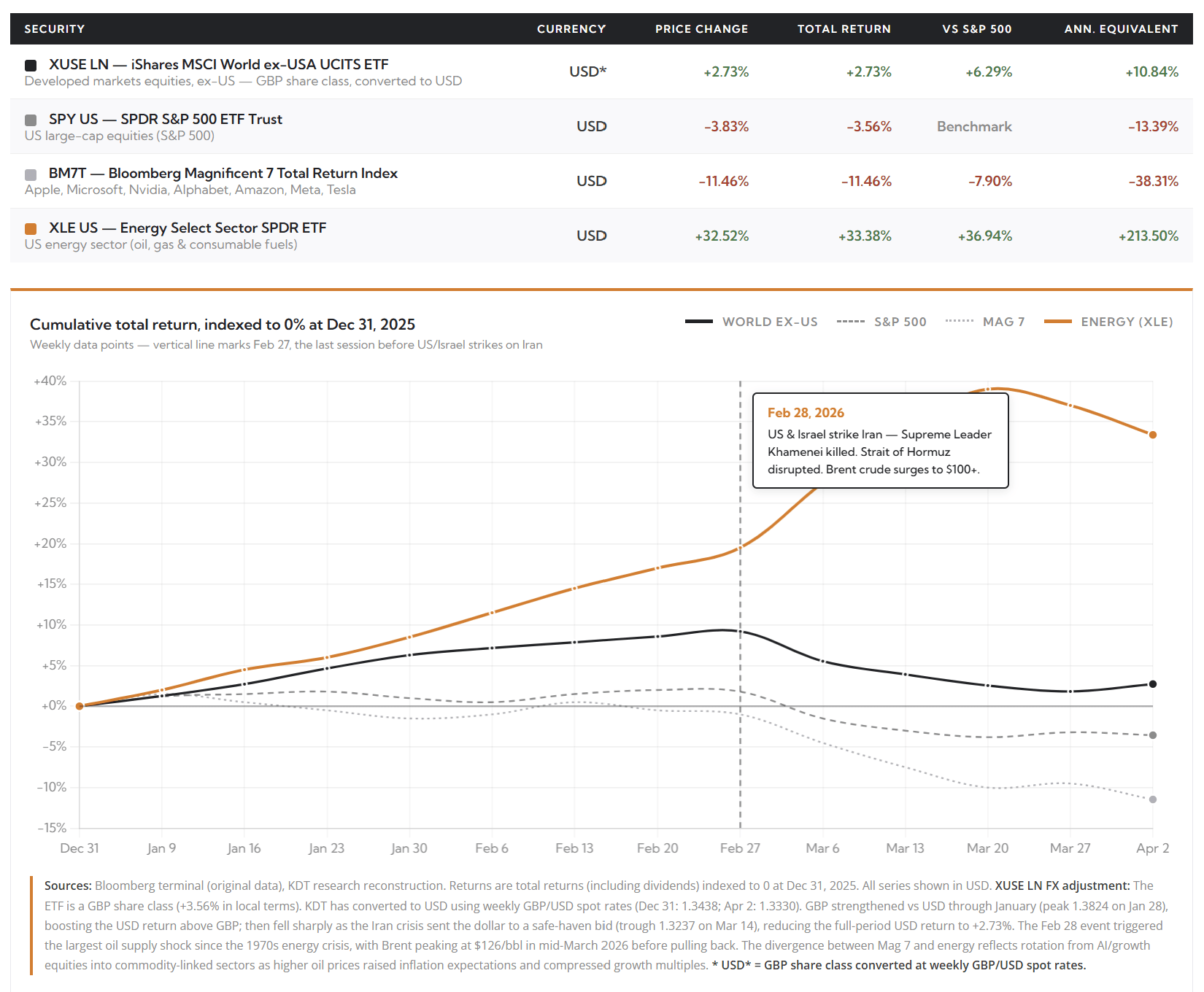
Since the assassination of Ayatollah Ali Khamenei, on February 28th, the market’s attention has focused on events in the Middle East. The closure of the Strait of Hormuz has been of particular concern. Almost 20% of the global supply of oil (18 to 19 million barrels) passed through the Strait every day up until the crisis. Oil is not the only commodity which passes through. Large quantities of Fertilizer, Urea, Aluminium and Sulfur also pass through the Strait. During March, the oil price and the S&P 500 were negatively correlated.
Non-US stocks were deemed to be more exposed, with non-US shares declining more than US shares (down -8% versus -6% for the S&P 500 in March). Interest rates also rose, and the US 2year Treasury Yield jumped from a low of 3.37% at the end of February to almost 4% by late March. It is worth noting that oil over $100/barrel (or $100/bbl) is not as impactful to the global economy as in the past: although the current price of $109/bbl is nominally higher than the 1973 and 1979 peaks of $11 and $40 a barrel and lower than the 2008 high of $147/bbl, one can also analyse this as a percentage of world GDP. $109/bbl x global consumption of 103 million barrels a day works out to approximately 3.6% of global GDP, versus an oil spend of 4.3% of global GDP in 1973, 8.1% in the 1979-1980 crisis and 7.2% in the 2008 oil peak.
It is not necessarily the case that continued conflict will be negative for stock markets. According to Yardeni Research, the S&P 500 has been higher two years after the past four major US military engagements, with gains of 31% to 44% following the Korean War, the Iraq War, the Gulf War and World War II. Yardeni believes that there is good value in the stock market at current levels. The forward Price to Earnings ratio of the S&P 500 peaked last year at 23x on the 27th October. This ratio has now declined 18% to 18.9x earnings. Over that same period, S&P 500 earnings for the next twelve months have risen 12.7%, reaching record highs. Price to Earnings ratios initially dropped due to concerns about the profitability of companies exposed to AI, then fell more quickly amid fears that the war would trigger a global recession. Analysts, however, have continue to raise their collective forecasts for the year, suggesting that if there is a slowdown, analysts can’t yet see it.
How Buybacks can be used when share prices are down
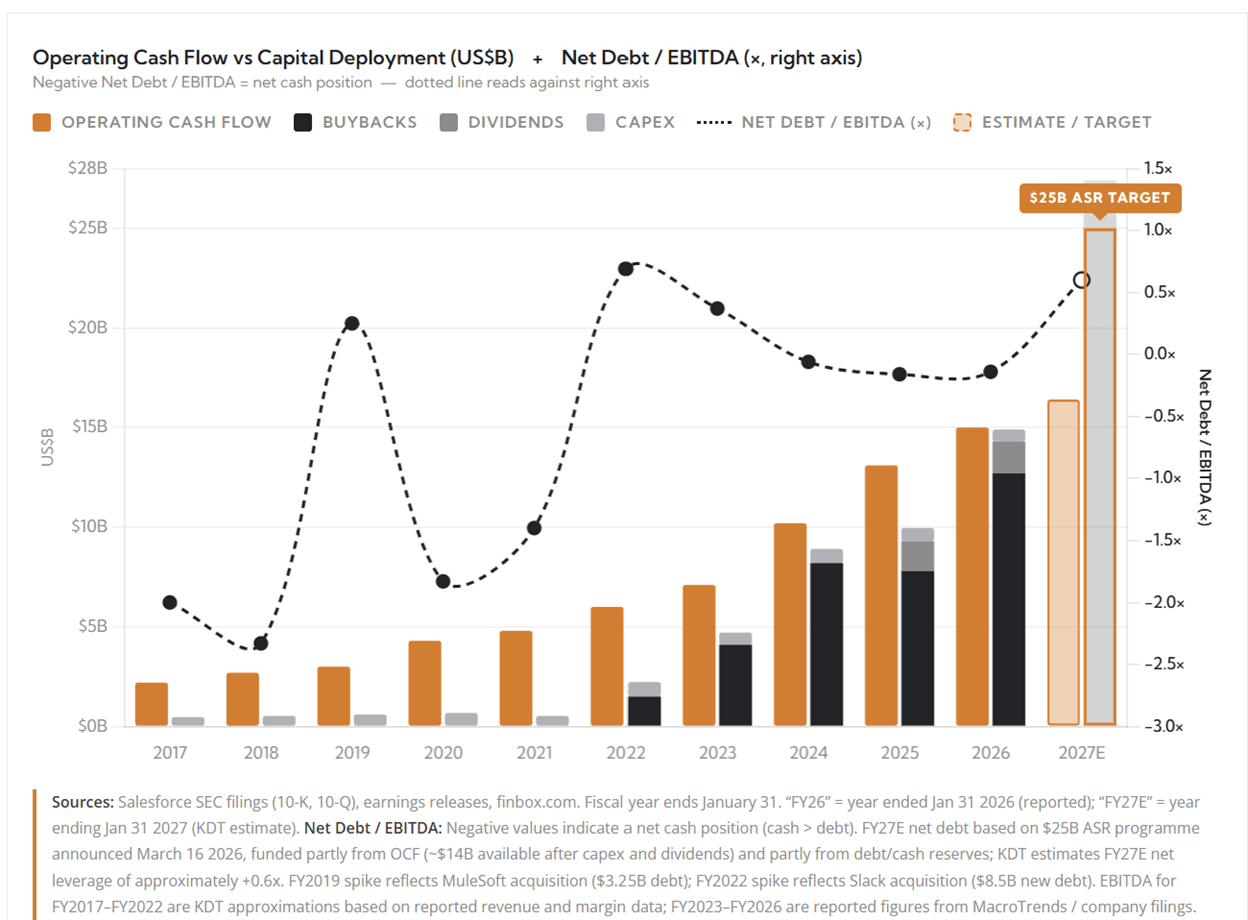
Unlike many other industries, software businesses have an advantage in that their capital expenditure requirements are not high, allowing these businesses to run at high profitability off a low capital base. This is also true of Consumer Staple businesses such as Procter and Gamble and Pepsi. There is a difference, however, in that more mature Consumer Staple businesses have dividend commitments and more debt to capital, while listed Software companies, for the most part, do not pay a large amount of profits out as dividends and have low debt to capital. Research from Morningstar this year suggested that companies are generally good buyers of their own stock. In this context, Salesforce’s March 2026 decision to commence a $25billion accelerated buyback program (“ASR” or Accelerated Share Repurchase of 15% of Salesforce’s market capitalisation), in addition to Thomson Reuters $600million share consolidation program, are positive signs for the shares of both companies which are respectively down 48% and 57% from their highs.
Microsoft spends about half of its operating cash flow on Capital Expenditure (a departure from 2016). Companies like Visa and Apple, however, have relatively low dividend and capital expenditure commitments, and spend the vast majority of their operating cashflow on buybacks. As a non-US shareholder, buybacks are very attractive as investors are not subject to withholding taxes as they would be with dividends. Amazon and Tesla, amongst the Magnificent Seven, spend very little on share buybacks, with Amazon’s 2022 $10billion buyback announcement (about 0.4% of market cap) still only 60% completed.
2026 Initial Public Offerings
As mentioned in the last newsletter, 2026 is anticipated to be the year of IPOs. SpaceX (estimated market cap at listing-$1.5trillion to $1.75trillion or over 100x 2025 revenue of $16billion) has filed a “confidential” S-1, with the listing expected to be in June of this year. Anthropic and OpenAI are also expected to list this year.
SpaceX’s IPO will aim to raise as much as $75billion. The conglomerate will include xAI (Grok), Starlink, the Rocket program and X (formerly Twitter). One has to go quite far back to look for an IPO where the private company almost immediately became one of the largest companies in the index. The closest analogue is perhaps Ford’s $657million IPO in 1956. Ford entered the 1956 fortune 500 at number 3, only behind General Motors and the Standard Oil Company of New Jersey (the company that would later become Exxon). Henry Ford had never wanted the Ford Motor Company to go public, but high inheritance taxes signed into law in 1935 meant that the family had to restructure their assets prior to Henry Ford’s death, with 88% of the economic benefit going to a Foundation holding “A” class shares, representing 95% of the company but no voting rights. The Ford family held onto 5% of the company through Class B shares, which held 100% of the voting rights. By 1954, seven years after Henry Ford’s death, the Ford Foundation president felt that the foundation was too exposed to the cyclical nature of the auto business and he began exploring the possibility of selling part of its Ford stake. The resultant IPO was so big that over 200 banks participated. The Ford IPO appeared to prioritise retail shareholders, with the New York Times reporting that “underwriters and participating dealers were under contract not to fill orders for more than 100 shares unless they could not otherwise dispose of their stocks”. Similarly today, Reuters reported Elon Musk is discussing allocating as much as 30% of SpaceX’s initial public offering to individual investors, at least three times the usual retail allocation.
Like with Ford, OpenAI’s leaked capitalization table shows that a Foundation (the OpenAI Foundation) owns 26% of the company, or 2.6million shares. There is one large difference, in that the OpenAI Foundation has “special voting and governance rights” that allow it to appoint all members of the for-profit OpenAI Group’s board of Directors.
It is possible for investors today to gain exposure to OpenAI, Anthropic and SpaceX without needing to wait until the IPO. The Private Shares Fund, a US-regulated quarterly-dealing interval fund, has a 7% allocation to SpaceX as at 31st March 2026, while the Scottish Mortgage Investment Trust lists SpaceX as its largest position (15% is invested in SpaceX and 37% of the fund is invested in Private Assets). Cathie Wood’s ARKK also holds a 3% allocation to OpenAI, having bought at a $850billion valuation (42x 2025 revenue).
Some listed companies also have exposure today to OpenAI, Anthropic and OpenAI. OpenAI has the most diverse ownership base amongst listed companies – Microsoft owns 27% of OpenAI, while Amazon (4.7%), Nvidia (3.5%) and Softbank (11.7%) are also major shareholders. Echostar (market cap $37billion) owns between 2% to 3% of SpaceX equity, valued at roughly $11billion. Zoom Communications made an early investment of $51million into Anthropic in 2023, looking to invest in AI given the importance of AI in video calls. At the latest funding round where the company was valued at $380billion (or 38x 2025 revenue), Zoom has made a 78x return as the stake is now worth $5billion. This means that today, Zoom’s $24billion market capitalization includes $8.7billion in cash, $1billion of annualized income and a stake in Anthropic potentially worth $5billion.
Although it is likely, give the sheer size of these IPOs, that there will be volatility, a 1998 Washington Post article points to how Ford remained a successful investment even 40+ years after the IPO. The writer’s (James Glassman) grandfather had been a broker in 1956 and had bought a single share of Ford at the IPO for about $30, giving it to Glassman for his ninth birthday. In 1956, Ford was valued at about $3.2billion, or about 70% of 1956 revenues. By the start of 1998, Glassman (due to several stock splits), now owned 16 shares of Ford, while his grandfather’s original $30 gift had turned into an investment worth $827.84 with an annual dividend of $26.88. Glassman calculated that, had dividends been reinvested, an investment of $1,000 in Ford in 1956 would have been worth more than $98,000 at peak valuation in 1998.